Archery Classes Near You: How to Find, Choose, and What to Expect in 2026
Archery classes are structured lessons that teach shooting fundamentals, safety, and equipment handling under a trained instructor. To find archery classes near you, use the USA Archery club finder, search Google Maps for local ranges, or check YMCAs, sporting goods stores, and rec centers. Most beginner classes cost $20 to $50 per session and provide loaner gear.
Here’s the honest truth about starting archery: the hardest part isn’t the shooting. It’s figuring out where to actually take a class. Search “archery classes” and you get a wall of individual club pages, each assuming you already know what you’re looking for. None of them explain the landscape. That’s what this guide does.
By the time you finish reading, you’ll know exactly what kinds of classes exist, how to locate them in your zip code, what a good instructor looks like, what you’ll pay, and what actually happens in your first session. We shoot competitively and we’ve been through every one of these formats, so we’ll tell you what works and what to skip.
Types of Archery Classes Available
Not all archery classes are built the same. The format you pick shapes your cost, your pace, and how fast you improve. Here are the six main types you’ll run into.
Group Beginner Classes
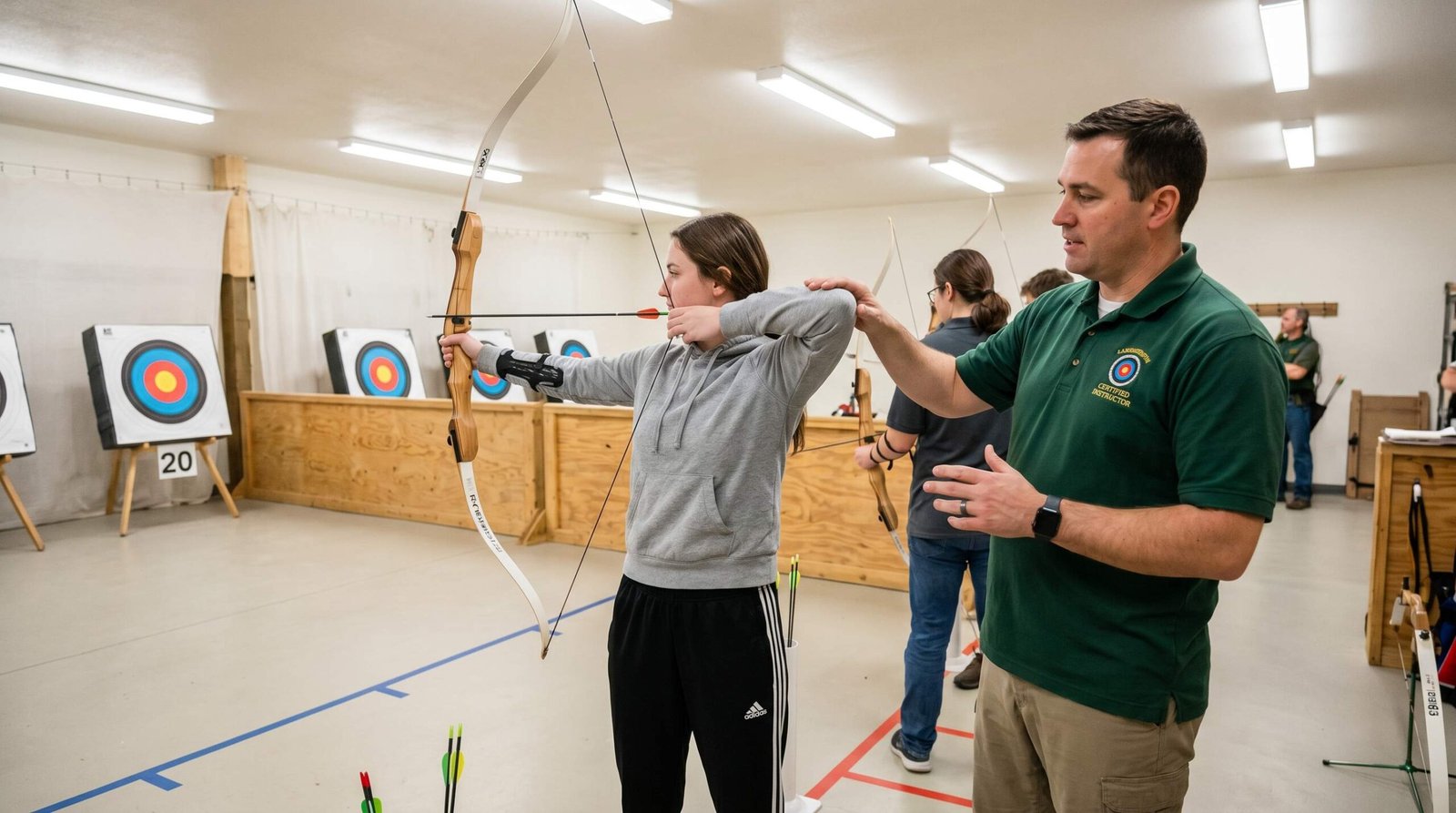
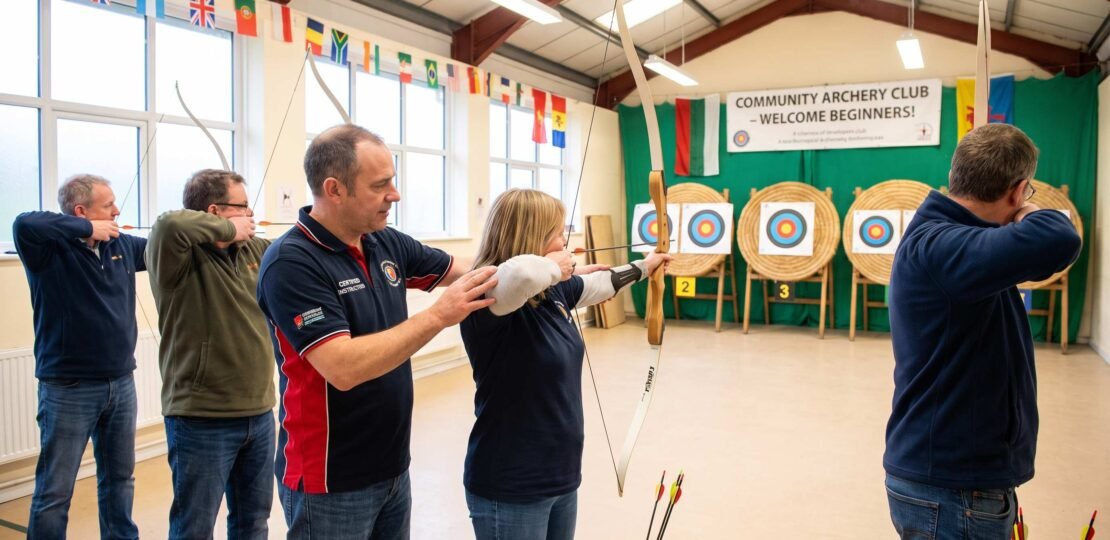
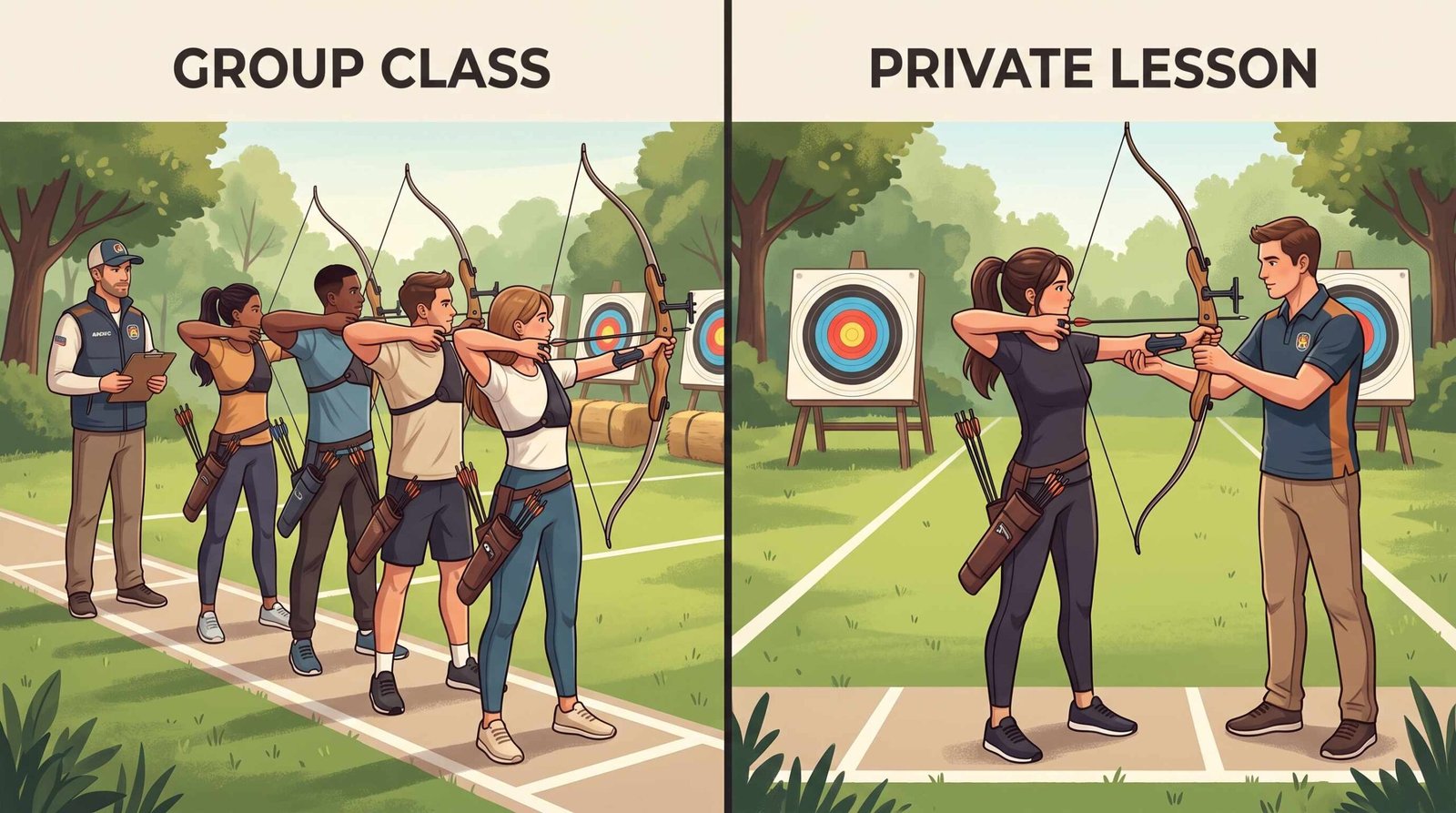
This is where most people start, and for good reason. A group beginner class puts you in a room with 6 to 12 other newcomers, an instructor at the front, and a set schedule. You learn the same fundamentals everyone learns: stance, grip, anchor point (the fixed spot on your face where your drawing hand settles every shot), and release. Classes usually run 60 to 90 minutes and often come as a package of four to eight sessions.
The upside is cost and comfort. You’re not the only clueless person in the room, and splitting the instructor’s time across a group keeps the per-session price low. The downside is pace. If you catch on faster than the group, you’ll wait around. If you’re slower, you might feel rushed. For 90 percent of beginners, though, group classes are the right call.
Private Lessons
Private lessons are one-on-one time with a coach. Everything gets tailored to you: your build, your goals, the quirks in your form. A coach watching only you will catch a dropped elbow or a creeping anchor point in seconds, mistakes a group instructor might miss for weeks.
You pay for that attention. Private sessions cost two to four times what a group class does per hour. We suggest private lessons if you’re chasing competition, fixing a specific problem, or you simply learn better without an audience. Many archers do a group course first, then book private sessions once they know they’re serious. For a deeper look at how skill builds over time, our guide to private archery lessons and skill progression breaks down what that longer arc looks like.
Club Membership
Archery clubs work like a gym membership. You pay monthly or annually, and in exchange you get range access, equipment storage, and usually some coaching mixed in. Clubs are less about a fixed curriculum and more about a place to practice regularly with people who know what they’re doing.
This format shines once you’ve got the basics down and just need reps. Many clubs run beginner clinics for new members, so it’s not a bad entry point either. The catch is that a club assumes some self-direction. Nobody’s holding your hand through a lesson plan unless you sign up for one.
Drop-In Experiences
Drop-in sessions are the “try it once” option. No package, no commitment, just a single visit where staff set you up with gear and give you a quick safety rundown before you start flinging arrows. Escape-room-style archery tag venues and some ranges offer these.
Drop-ins are great for a birthday, a date, or scratching a curiosity itch. They are not a real way to learn. You get almost no instruction on form, so treat them as entertainment, not education. If you fall in love with the sport during a drop-in, then go find a proper class.
Youth Classes
Youth archery classes are designed for kids, typically ages 8 to 17, with lighter equipment, shorter sessions, and instructors trained to keep young shooters engaged and safe. Programs like the National Archery in the Schools Program (NASP) and Junior Olympic Archery Development (JOAD) run structured youth tracks that can carry a kid all the way to competition.
If you’re a parent, look for classes that group children by age and skill. A 9-year-old and a 16-year-old have very different needs. Good youth programs also cap class size tightly, because supervision matters more when the archers are small. Archery also builds focus and patience in a way few youth sports do, and it puts kids of every body type on equal footing, there’s no bench, no cut, and no size requirement.
Adult-Only Classes
Plenty of ranges run adult-only classes, and they fill a real gap. Adults learn differently than kids, ask different questions, and sometimes just don’t want to share a lane with a squad of tweens. These USA Archery adult program offerings move at a grown-up pace and often lean into the social side, wine-and-archery nights are a real thing.
Adult beginners sometimes psych themselves out, convinced they’re too old or too uncoordinated to start. You’re not. Archery rewards patience and focus far more than raw athleticism, and adult-only classes exist precisely because so many people pick this up later in life.
Class Types at a Glance
| Class Type | Cost per Session | Equipment Provided | Best For | Commitment |
|---|---|---|---|---|
| Group Classes | $20 to $50 | Yes, loaner gear included | Total beginners on a budget | Multi-week package (4 to 8 sessions) |
| Private Lessons | $50 to $120 | Usually, sometimes bring your own | Competitors and fast learners | Flexible, book as needed |
| Club Membership | $30 to $80 per month | Range access, storage; gear varies | Regular practice after basics | Monthly or annual |
| Drop-In Experience | $25 to $45 | Yes, everything provided | One-time fun, parties, dates | None, single visit |
How to Find Archery Classes Near You
Finding classes is where most beginners stall out. Archery ranges rarely dominate search results the way restaurants do, so you need to know the right tools. Here are the six methods we actually use, ranked roughly by how reliable they are.
USA Archery Club Finder
Start here. USA Archery is the national governing body for the sport, and its website hosts a club finder that maps certified clubs and instructors by location. Because these clubs meet USA Archery standards, you’re far more likely to get a trained, insured, legitimate instructor rather than someone’s uncle with a bow.
Plug in your city or zip code, and you’ll get a list of nearby clubs with contact info. Call or email them directly. Many clubs don’t advertise their beginner classes well online, so a quick message asking “do you run beginner classes?” often uncovers options you’d never find otherwise.
Google Maps Search Tips
Google Maps is your second-best tool, but you have to search smart. Don’t just type “archery classes.” Try these instead: “archery range near me,” “archery lessons [your city],” and “archery lanes.” Ranges list themselves under different categories, so casting a few different search terms catches places a single query misses.
Once you find a range, read the reviews with a filter for the word “beginner” or “lesson.” Reviews tell you whether a place actually welcomes newcomers or caters mostly to experienced shooters buying gear. A range with a five-star rating from bowhunters might not run a single beginner class.
Archery 360
Archery 360 is an education and community resource that publishes beginner content and helps people locate ranges. If you’re brand new and want to understand the sport before you walk in a door, Archery 360 is worth a browse. It’s less a directory and more a friendly on-ramp, with articles that answer the questions beginners are too shy to ask.
Sporting Goods Stores
Big outdoor retailers sometimes run archery ranges and classes inside the store. Even when they don’t teach, the archery department staff usually know every range and instructor within 50 miles, because those are the people they sell arrows to. Walk up to the counter and ask. It’s the most underused tip on this list.
YMCA and Rec Centers
Your local YMCA, community center, or parks and recreation department often runs seasonal archery classes at a fraction of what a dedicated range charges. These programs are aimed squarely at beginners, use loaner equipment, and cost less because they’re subsidized. Check your city’s rec department website or grab the seasonal activity catalog. Summer camps for kids are especially common here.
Local Archery Communities
Facebook groups, Reddit’s archery communities, and local shooting forums are goldmines. Post your city and ask where beginners should take a class, and experienced local archers will point you to the good instructors and warn you off the bad ones. These people have opinions, and their opinions save you money and frustration.
One more tip that ties all six methods together: when you call a range, ask specifically about their next beginner intake date. Many classes run in seasonal blocks rather than continuously, so a place might genuinely offer great beginner instruction but not have a class starting for three weeks. Knowing the schedule up front stops you from crossing a good range off your list just because the timing looked off on the day you happened to check.
What to Look for in an Archery Instructor
A great instructor accelerates your progress. A bad one teaches you habits you’ll spend years unlearning. Here’s how to tell them apart before you hand over your money.
USA Archery Certification
USA Archery runs a tiered coaching certification program: Level 1, Level 2, Level 3, and up. A Level 1 or 2 certified instructor has proven they know how to teach safely and correctly. Ask directly, “Are you USA Archery certified, and at what level?” A confident, credentialed coach answers without hesitation. The USA Archery certification standards exist so beginners don’t have to guess whether an instructor knows what they’re doing.
Certification isn’t everything, some brilliant coaches learned through decades of competition, but for a beginner it’s the single best filter. It tells you the person has been vetted on both technique and safety.
Experience With Beginners
Teaching beginners is a specific skill. A national-champion archer might be a terrible teacher for someone who’s never held a bow. Ask how many beginner classes the instructor has run and whether they enjoy teaching newcomers. You want someone patient who explains the “why” behind each instruction, not just barks commands.
Class Size
Smaller is better, up to a point. For a group beginner class, we suggest a ratio of no more than 8 students per instructor. Beyond that, you get individual feedback rarely, and safety supervision thins out. Ask how many people are in the class before you sign up. If they say 20 students and one coach, walk away.
Equipment Provided
A good beginner program supplies everything: bows, arrows, arm guards, and finger tabs (a small leather flap that protects your fingers from the bowstring). You should never need to buy gear before your first class. If an instructor demands you show up with your own equipment as a beginner, that’s a red flag, they’re not set up to actually teach newcomers.
How Much Do Archery Classes Cost?
Archery is cheaper to try than most people expect. You’re not buying skis or a road bike. Here’s the real pricing landscape so you can budget without surprises.
A single group beginner session runs $20 to $50. Multi-week packages of six to eight sessions typically land between $120 and $300, which works out cheaper per class than paying one at a time. Private lessons cost more, $50 to $120 per hour depending on the coach’s credentials and your region. Club memberships run $30 to $80 a month, and drop-in experiences sit around $25 to $45 for a one-off visit.
Two costs catch beginners off guard. First, range fees. Some venues charge a lane fee on top of the lesson, usually $10 to $20. Second, equipment. Classes provide loaner gear, but once you’re hooked you’ll want your own bow. Budget a few hundred dollars for a starter setup when that day comes, and check our guide to the best archery targets for beginners if you plan to practice at home.
| Class Category | Typical Price Range | What’s Usually Included |
|---|---|---|
| Single group session | $20 to $50 | Instruction, loaner bow and arrows, range time |
| Multi-week group package | $120 to $300 | 4 to 8 sessions, all gear, structured curriculum |
| Private lesson (per hour) | $50 to $120 | One-on-one coaching, gear often included |
| Club membership (monthly) | $30 to $80 | Range access, storage, member clinics |
| Drop-in experience | $25 to $45 | Quick safety brief, all equipment, single visit |
| Youth program (per season) | $60 to $200 | Multiple sessions, sized gear, trained youth coaches |
What to Expect in Your First Archery Class
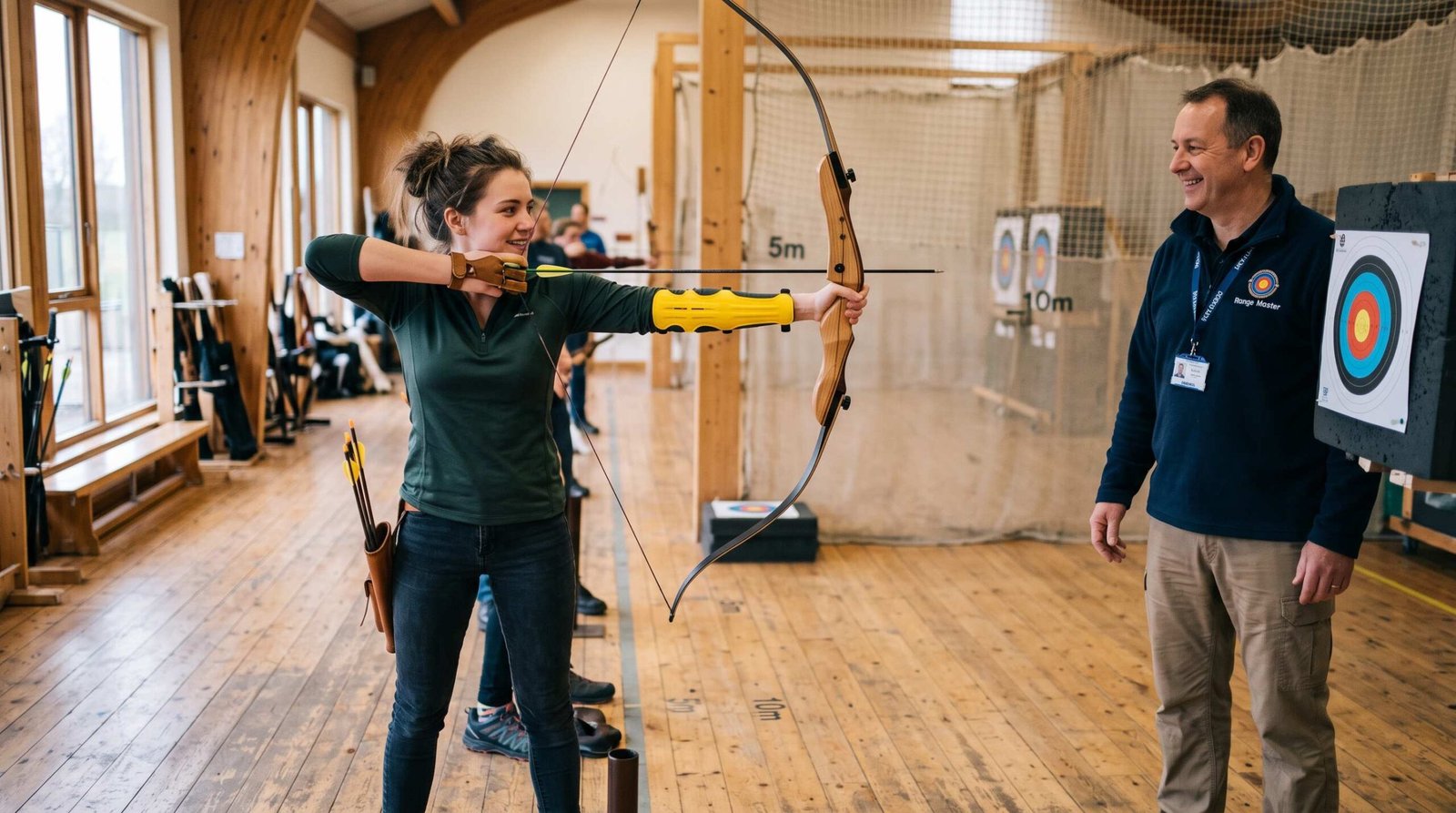
Walking into your first class is less intimidating when you know the script. Here’s exactly how a typical beginner session unfolds, step by step.
Step 1: The Safety Briefing
Every legitimate class starts with safety, no exceptions. The instructor covers the range rules: when to shoot, when to stop, where to stand, and how to retrieve arrows. You’ll learn the whistle or verbal commands that signal “shoot” and “hold.” This part feels slow when you’re itching to shoot, but it’s non-negotiable. Pay attention.
Step 2: Equipment Introduction
Next, the instructor fits you with gear and explains each piece. You’ll get a bow sized to your draw length and strength, arrows, an arm guard to protect your forearm from the string, and a finger tab or glove. They’ll show you how to nock an arrow (clip it onto the bowstring) and how to hold the bow correctly. Ask questions here. Understanding your gear makes everything after this easier.
Step 3: Your First Shots
Now the fun part. The instructor walks you through the shot sequence: stance, grip, draw, anchor, aim, release. Your first arrows will probably miss the target entirely, and that’s completely normal. Everyone’s first shots are ugly. The instructor watches your form and makes small corrections, and within a dozen arrows you’ll start landing on the target. That first thunk into the target face is a feeling you won’t forget.
Step 4: What to Bring
Keep it simple. Wear close-fitting clothes, a loose sleeve can catch the string and sting. Tie back long hair. Skip dangly earrings and necklaces. Closed-toe shoes are a must. Bring water and, honestly, that’s it. The class provides the rest. Show up 10 minutes early to fill out any waiver and get settled.
Expect to leave your first class with sore fingers and a slightly tender forearm, that’s the string doing its job, and it fades within a session or two as your body adjusts. You might also feel a light ache in your upper back the next day, which is a good sign. It means you’re pulling with the right muscles instead of muscling the draw with your arm. Neither of these should hurt sharply. If something pinches or stings badly, tell your instructor right away, because it usually points to a fixable gear or form issue.
Choosing the Right Archery Class for Your Skill Level
The right class depends entirely on where you’re starting and where you want to end up. Match the class to your goals, not the other way around.
If you’ve never touched a bow, take a group beginner class or a beginner archery class package. Full stop. You’ll learn safety and fundamentals in a low-pressure setting for the least money. There’s no shortcut worth taking here, and archery classes for beginners exist precisely because starting right matters.
If you’ve shot a handful of times and want to get serious, move to private lessons or an intermediate class. You’ve got the basics; now you need refinement. A coach focused on you will polish your form and start building consistency, the thing that separates casual shooters from good ones.
If you’re aiming at competition, you need a coach with a competitive background and access to a club that runs tournaments. Ask potential coaches whether they’ve trained competitive archers and whether the club hosts or attends events. At this level, the environment matters as much as the instruction. Regular practice against other serious archers pushes you in ways solo shooting can’t.
Adults with zero experience deserve their own note. Archery classes for adults are widely available, and you should seek them out if you’d feel more comfortable learning alongside other grown-ups. The fundamentals are identical, but the pace and social vibe suit adult learners better.
Recurve vs. Compound Archery Classes: Which Should You Start With?
Most beginners face this fork early: learn on a recurve bow or a compound bow? Here’s the short version so you can pick a class with confidence.
A recurve bow is the classic, elegant design you see at the Olympics. Its limbs curve away from the archer, and it has no mechanical aids. Recurve archery teaches you raw fundamentals, form, back tension, and instinct, because there’s nothing hiding your mistakes. Most beginner classes and school programs start here, and we generally suggest it as the foundation. If you’re leaning recurve, our breakdown of recurve bows for beginners covers what to look for in your first bow.
A compound bow uses a system of cams and pulleys that make it easier to hold at full draw and generally more accurate for a new shooter. Compounds are the standard in bowhunting and many target disciplines. If your end goal is hunting or you just want to hit the bullseye sooner, a compound-focused class makes sense. Our guide to compound bows for beginners explains how these bows work and what a good starter model costs.
Our honest take: if a class near you teaches recurve and you have no strong preference, start there. The skills transfer, and learning on a recurve first makes you a better archer on any bow. That said, the best class is the one you can actually get to. Don’t drive two hours for a recurve class when a solid compound class sits 10 minutes away.
Frequently Asked Questions About Archery Classes
How much do archery classes cost?
Archery classes typically cost $20 to $50 per group session, or $120 to $300 for a multi-week beginner package. Private lessons run $50 to $120 per hour, and club memberships cost $30 to $80 per month. Most beginner classes include loaner equipment, so you won’t need to buy gear to get started.
What age can you start archery classes?
Most archery classes accept students starting around age 8, when kids have the strength and focus to handle a bow safely. Some youth programs take children as young as 6 with lighter equipment and heavy supervision. There’s no upper age limit at all. Plenty of people take up archery in their 60s and 70s.
Do I need to own a bow to take archery classes?
No. Nearly all beginner archery classes provide loaner bows, arrows, arm guards, and finger tabs as part of the fee. You should never buy your own equipment before your first class. Wait until you’ve shot a few times and know your preferences, then invest in a bow that fits you properly.
How long does it take to get good at archery with classes?
You’ll hit the target consistently within your first few classes. Reaching a solid intermediate level, tight groupings and reliable form, usually takes three to six months of regular practice. Competitive skill takes years. Archery is easy to start and endlessly deep, which is exactly why people stick with it.
What is the difference between archery classes and private archery lessons?
Archery classes are group sessions where an instructor teaches several beginners the same fundamentals, and they cost less per session. Private lessons are one-on-one, fully tailored to your form and goals, and cost two to four times more. Beginners usually start with group classes, then add private lessons once they get serious.
Can adults start archery classes with zero experience?
Absolutely. Many archery classes are designed specifically for adult beginners with no prior experience. Archery rewards patience and focus far more than athleticism, so adults often pick it up quickly. Look for adult-only classes if you’d prefer to learn alongside other grown-ups rather than in a mixed-age group.
Is archery safe for beginners?
Yes, archery is one of the safest sports when practiced with proper instruction. Injury rates are lower than golf, and every legitimate class starts with a thorough safety briefing covering range rules and commands. Trained instructors supervise beginners closely, so as long as you follow the rules, the risk is minimal.