

Best Archery Targets for Beginners: How to Choose the Right Type for Your Bow (2026)
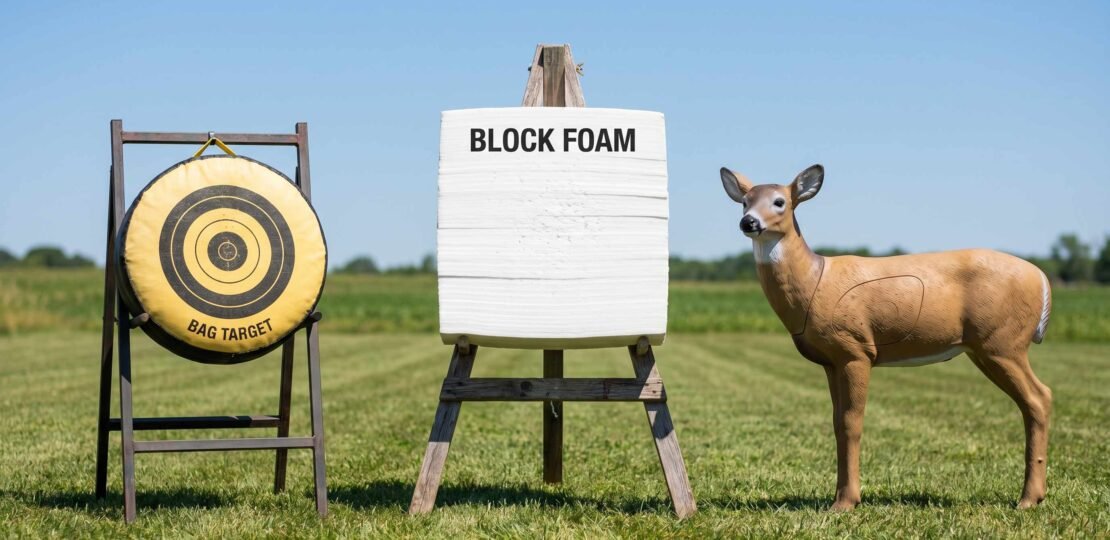
The best archery target for beginners is a bag target. Bag targets stop arrows gently, allow easy hand-pull removal at lower draw weights, and cost $20-80. If you shoot a compound bow above 40 lbs, choose a block foam target instead because high-speed compound arrows bury too deeply into bag fill. Match the target to your bow first, then worry about brand.
If you just unboxed your first bow, the question burning in your head is probably not “which $300 3D elk replica should I buy?” It is “what kind of target will actually work and not waste my money?” Every roundup article on the internet skips that step. They assume you already know whether you need a bag, a block, or a 3D foam buck. That assumption costs beginners money, because the wrong target type for your bow means stuck arrows, busted nocks, and a $90 cube that gets stored in a shed after week two.
This guide answers the question the others skip. We will walk through every target type, match each one to a bow style, cover the backstop and stand you actually need, and finish with specific product lines worth looking at in 2026. If you are still deciding between bows, also check out our guide on your recurve bow options or our breakdown of the best compound bow picks for new shooters. And if you are brand new to the sport, taking a few archery lessons before spending money on gear is the single best investment you can make.
What Makes a Good Archery Target?
Five things separate a target you will love from a target you will return. Get these right and the rest is brand preference.
Arrow stoppage power. A target’s job is to stop an arrow without letting it pass through. Stoppage depends on the target’s density, thickness, and how it is matched to your arrow speed. A 20-lb recurve sends arrows at roughly 130 feet per second. A 70-lb compound throws them past 300 fps. If you put a beginner bag target in front of a fast compound, the arrow can punch through the back wall. The product packaging will give a maximum bow speed or poundage rating. Trust it.
Ease of arrow removal. This is the number one frustration for new archers, and it ruins the practice habit faster than anything else. Bag targets pull easy. Foam blocks pull moderately. 3D foam pulls hard, sometimes requiring an arrow puller tool or two hands and a knee on the target. We suggest pulling sample arrows at a local archery pro shop before you commit to a $150 cube you cannot get arrows out of.
Durability and shot capacity. Manufacturers rate targets by total shot count. A quality bag target rated for 40,000+ shots will outlast a beginner’s entire first year easily, even shooting 50 arrows per session three times a week. Block foam targets routinely hit 100,000+ shots on the high-end face. If the box does not list a shot rating, that is a yellow flag.
Tip compatibility. Field points and broadheads are not interchangeable for targets. Field points are blunt, bullet-shaped tips for practice. Broadheads are the razor-blade hunting tips. Field points pull cleanly from most targets. Broadheads will shred a bag target on the first shot and ruin many foam blocks. Most beginners shoot field points exclusively for the first year or two, and that is the right call. Buy a target rated for field points and you will save money.
Portability. A 60-lb foam block is great until you have to move it. If you plan to shoot at different ranges, a bag target or a smaller cube travels better.
The 5 Types of Archery Targets Explained
There are five target types worth knowing. Pick the one that matches your bow and goals. Skip the rest.
Bag Targets
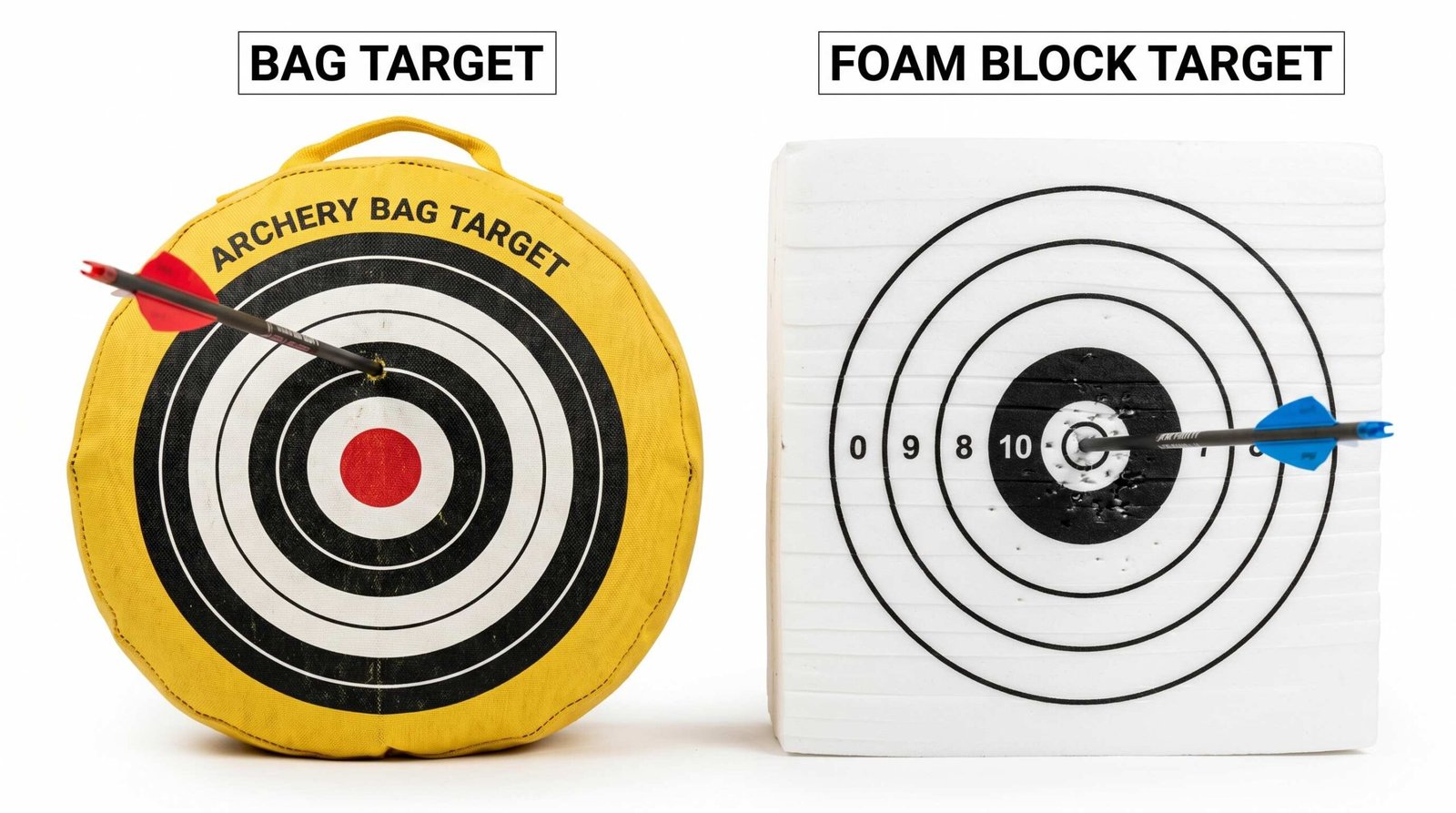
Bag targets are exactly what they sound like: heavy-duty fabric bags filled with compressed synthetic fiber or recycled fill. They are the most beginner-friendly target on the market for one simple reason: arrows slide in and pull out with one hand.
They work brilliantly for recurve, longbow, and beginner-level compound setups. The fill compresses around the arrow shaft, gripping just enough to stop it but releasing easily on the pull. Pricing runs $20-80 for full-size bags. A 24-inch face is plenty for backyard practice at 10-20 yards.
The catch: bag targets hate moisture. Leave one out in a rainstorm and the fill mats together, the bag sags, and the lifespan drops by half. They are also field-point only. A broadhead will rip the cover open in one shot. If you are shooting indoors or have a covered storage spot, a bag target is the right starting purchase for almost every beginner.
Block and Foam Targets
Block targets are dense layers of self-healing foam stacked into a cube or rectangle. The layered design lets foam compress around the arrow, then bounce back when you pull it out. The result is a target that handles much higher arrow speeds than a bag, which is why they are the standard pick for compound shooters.
Most block targets are dual-rated for field points and many can handle broadheads on designated faces. Shot capacity climbs past 100,000 for high-end models. Pricing sits in the $40-150 range. The trade-off is firmer arrow removal, especially after the foam has compressed around hundreds of shots in a small grouping zone. Block targets also tolerate weather far better than bags, though we still suggest covering them or moving them under an eave between sessions.
3D Targets
3D targets are foam animals – deer, turkey, hog, bear, elk – designed for bowhunters practicing realistic angles. They are gorgeous and they are not for beginners. Pricing starts around $80 for small game replicas and climbs past $400 for life-size whitetail or elk models.
The reason we steer beginners away: arrow removal on 3D foam is brutal. The foam is denser than block targets and the vital zone gets shot to mush quickly. Replacement vital cores cost $30-60. A first-year archer learning form will spend more time wrestling arrows out than shooting. Save 3D targets for year two or three, once your groups have tightened and you are seriously preparing for hunting season.
Paper and Face Targets
Paper targets are the printed circles, animal silhouettes, or grid faces you tack onto a backing. They are not standalone. You need a bag, block, or foam board behind them to actually stop the arrow. Packs of paper faces cost $5-20 and last anywhere from one session to a few weeks depending on how tight your groups are.
Paper faces matter for two reasons. First, they show your groupings clearly, which is the fastest way to diagnose form issues. Second, they let you measure progress quantitatively, which keeps beginners motivated. Every serious archer uses paper faces on top of a bag or block target during form practice.
Field and Cube Foam Targets
Cube foam targets are solid foam blocks with shootable faces on multiple sides, sometimes all six. You rotate the cube when one face wears down, which extends total life dramatically. They handle field points easily and many tolerate lighter broadheads on dedicated sides.
Cube targets sit between bag and block in terms of arrow removal, leaning easier. Pricing runs $30-100 for beginner-friendly sizes. They are an excellent middle-ground choice if you are not sure whether to start with a bag or a block, and they hold up to weather better than bags.
| Target Type | Best For | Arrow Removal | Durability | Price Range | Weather Resistance |
|---|---|---|---|---|---|
| Bag | Beginners, recurve, field points | Easy | Moderate (30-50K shots) | $20-80 | Poor, store indoors |
| Block/Foam | Compound, intermediate | Moderate | High (100K+ shots) | $40-150 | Good |
| 3D | Bowhunters, intermediate+ | Firm | Moderate | $80-400+ | Good |
| Paper/Face | Form practice (needs backing) | N/A | Low (single use) | $5-20/pack | N/A |
| Cube Foam | All skill levels, field points | Easy-Moderate | High | $30-100 | Good |
Matching Your Target to Your Bow (and Why It Matters)
This is the step every other guide skips. The right target for a 30-lb recurve is the wrong target for a 65-lb compound, and vice versa. Picking by bow style first saves you frustration and money.
Recurve Bow Users
If you shoot a your recurve bow in the typical beginner draw weight range of 20-35 lbs, a bag target is your answer. The lower arrow speed means the arrow embeds a few inches into the bag fill, which is exactly where the bag is designed to grip and release easily. You will pull arrows with one hand and stay in a rhythm.
Block targets also work for recurve shooters, especially at the higher end of the draw weight range. What you want to avoid is a dense 3D foam target. At recurve draw weights, arrows often will not even penetrate the vital core fully, and what does go in can be impossible to pull out without an arrow puller and serious effort.
Compound Bow Users
If you shoot a compound bow at 40-70 lbs, a block or foam target is the match. Compound arrows travel fast enough to bury into a bag target up past the fletching, and once an arrow is that deep in compressed fill, removal becomes a two-hand wrestling match. Foam blocks are engineered for those higher arrow speeds and grip the arrow shaft with controlled, layered resistance.
For your first compound target, we suggest a mid-size foam block with replaceable faces. You will outgrow it slower than you think.
Traditional and Longbow Users
Traditional longbow shooters fall in the same bucket as recurve users. Bag targets are ideal, foam blocks at the higher draw weights are fine, and 3D should wait until your form is consistent and your draw weight has climbed.
| Bow Type | Recommended Target | Avoid | Why |
|---|---|---|---|
| Recurve (20-35 lbs) | Bag target | 3D targets | Easy arrow removal, arrows won’t embed deeply |
| Compound (40-70 lbs) | Block/foam target | Bag targets | High-speed arrows penetrate too deep into bag fill |
| Traditional/Longbow | Bag target | 3D (early on) | Same reasons as recurve |
| Any bow (form practice) | Paper face + foam backing | None | Shows groupings, diagnoses form issues |
Best Archery Targets of 2026 (by Category)
Rather than a brand-by-brand product roundup full of affiliate links, here are the specific product lines we point beginners toward in 2026, organized by category. These are the lines you will see at any well-stocked pro shop and read about consistently in pro shop conversations.
Best Bag Targets
The Morrell Double Duty line has been the go-to beginner bag target for over a decade. The 28-inch face gives plenty of margin for forgiving early-shot groupings, the fill is dense enough to handle compound shooters at the lower draw range, and arrow removal stays easy throughout the target’s life. Morrell rates the Double Duty for bow speeds up to 350 fps, which covers nearly every modern compound and every recurve in existence.
Black Hole targets are the second name worth knowing. Their Pro Series bag targets use a polypropylene fiber fill that genuinely lives up to the “easy arrow removal” marketing. Pricing sits in the $50-80 range and the build quality justifies it.
For absolute entry-level setups, the basic 18-inch bag targets from Field Logic and similar manufacturers under $30 will get a beginner through their first season. Just plan to upgrade once your group sizes shrink and you are putting arrows in the same hole.
Best Block and Foam Targets
The Block Infinity series is the most recommended foam target line for compound beginners, full stop. The 22-inch model in particular is the most popular all-rounder in the category. The polyfusion layered foam stops fast compound arrows reliably, the multiple face designs (target rings, animal vitals, dots) give variety, and the cube is rated for both field points and broadheads on dedicated sides.
Rinehart’s 18-1 target is the other heavyweight. Rinehart’s self-healing foam genuinely closes around arrow holes, and the 18-1 design gives you 18 different shootable spots before you need to rotate the target. Pricing is higher (often $130-160) but it is the last target many archers ever buy.
For shooters wanting to step toward 3D without the full commitment, Rinehart’s smaller 3D beginner options like the woodland animal series are excellent intermediate steps.
Best 3D Target for Beginners (When You Get There)
When you do graduate to 3D, McKenzie 3D targets are the standard reference. Their “Shotblocker” foam grade is specifically engineered to be more forgiving on arrow removal than tournament-grade 3D foam, which makes the deer, turkey, and small game models in this line ideal first 3D purchases. Replacement vital cores are widely available, which extends the target’s useful life by years.
| Pick | Type | Price Range | Best For | Key Feature |
|---|---|---|---|---|
| Morrell Double Duty | Bag | $50-80 | Recurve and beginner compound | Rated to 350 fps, easy pull |
| Black Hole Pro Series | Bag | $50-80 | Recurve, traditional | Polypropylene fill, low pull effort |
| Block Infinity 22″ | Block foam | $90-130 | Compound beginners | Polyfusion foam, multi-face design |
| Rinehart 18-1 | Cube foam | $130-160 | Long-term compound users | 18 shootable faces, self-healing foam |
| McKenzie Shotblocker 3D Deer | 3D | $150-250 | Bowhunting prep | Beginner-friendly foam grade, replaceable core |
| Field Logic Basic Bag | Bag | $20-30 | Ultra-budget starts | Lowest cost entry point |
Archery Target Stands: The Often-Forgotten Essential
Here is the question almost no roundup article asks: how are you actually holding this target up? Shooting at a target lying on the ground is unsafe (ricochets) and physically uncomfortable (you cannot get the right shooting angle). A stand is not optional.
Why a stand matters. A proper stand keeps the target stable through impact (so it does not tip over after one good shot), holds it at chest-to-shoulder height (which matches your shooting form), and keeps arrows off the ground (no broken arrows, no buried tips). Stability is the big one. A 40-lb bag target with a compound arrow hitting it will absolutely topple if it is just leaning against a fence post.
H-frame stands. Two vertical posts joined by a horizontal crossbar at the base, with a strap or rail to hold the target. These are the most common and most stable design. They handle target weights up to 40-50 lbs easily and run $25-60. We suggest this as the default first stand purchase.
Tripod stands. Three legs meeting at a single attachment point. They are lighter and pack down smaller for travel, but they are less stable for heavy targets. Tripods are great for portable bag targets but not ideal for big foam cubes. Expect to pay $20-40.
Integrated base targets. Some targets, particularly heavier foam cubes, come with built-in feet or a wide base that lets them sit on the ground stably. These can skip the separate stand entirely.
Sizing. Match your stand’s width to your target’s width plus 4-6 inches of clearance on each side. A 24-inch target wants a stand with 30-36 inches of crossbar width.
Make vs buy. An H-frame stand from a major archery brand runs $25-60 and lasts years. If you are handy and shooting a light bag target only, a DIY PVC frame can be built for around $10-20 in materials in an hour. PVC is fine for bag targets up to about 25 lbs but flexes too much for heavier foam.
| Stand Type | Price | Max Target Weight | Portability |
|---|---|---|---|
| H-frame | $25-60 | 30-50 lbs | Medium |
| Tripod | $20-40 | 15-25 lbs | High |
| DIY PVC | $10-20 material | 15-25 lbs | Medium |
Setting Up Your Backyard Archery Range Safely
The single biggest gap across competing articles is range setup. A target is one piece of a safe shooting setup. Skip the rest and you will lose arrows, dent fences, or worse.
Minimum distances. Ten yards is plenty for absolute beginners learning form, especially indoors or in small backyards. Twenty yards is the standard for general practice and matches most indoor competition distances. Thirty yards and beyond is intermediate territory where you are tuning sight pins and reading arrow flight. Start at 10, move to 20 once your groups are inside a paper plate, and do not push further until your form is locked in.
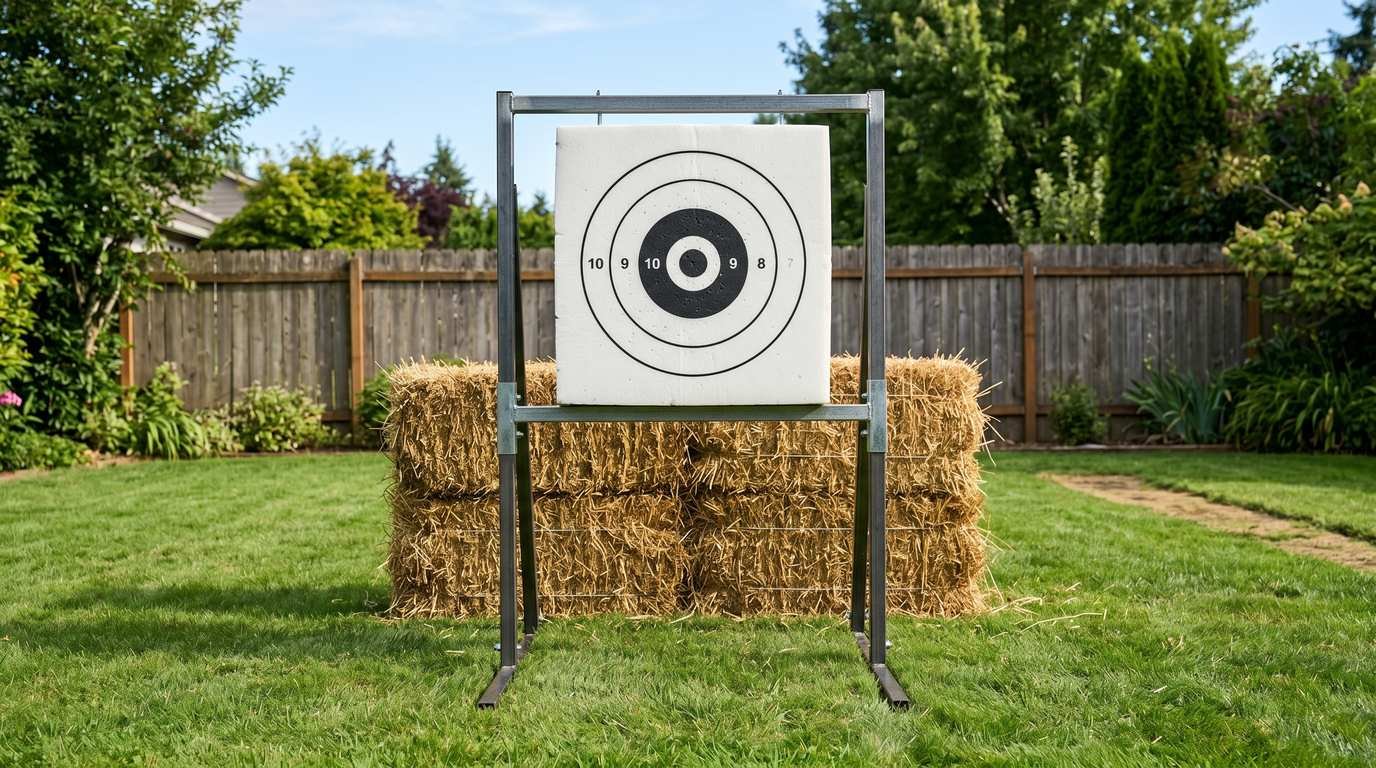
The backstop is non-negotiable. Your target is designed to stop arrows that hit it. It is not designed to catch arrows that miss it, and beginners miss often. The shot that sails three feet right of the target needs something behind it. Options worth considering:
- Hay bales. Cheap ($8-15 each), but you need 2-3 stacked to be reliable and they need replacing annually. Wet hay rots and arrows pass through.
- Archery safety netting. Purpose-built woven netting that catches stray arrows like a hockey net catches pucks. Runs $50-120 for typical backyard setups, lasts years, and is the most durable backstop option for permanent home ranges.
- Foam wall panels. For indoor and basement ranges, layered foam wall panels stop arrows that miss the target. More expensive but essential for indoor setups against drywall.
Safety clearance zones. Maintain at least a 10-foot buffer behind your backstop and 5 feet on each side. Never shoot in a direction where an arrow could possibly travel toward a road, structure, neighbor’s yard, or where people might walk. If your backyard cannot meet that, shoot at a club range instead.
For detailed guidance on building a backstop and calculating buffer zones, Archery 360 has an excellent step-by-step DIY guide. For club-level facility planning and longer shooting lanes, USA Archery’s facility planning standards give the official safety distances and lane specs used at sanctioned ranges. And if you are looking for a broader orientation to the sport before you set up at home, Elevation Equipped’s overview of getting started in target archery is worth a read.
Making Your Target Last: Arrow Removal and Maintenance Tips
Targets do not just wear out. They get destroyed by bad habits. Get these right and you will double the life of any target you buy.
Pull arrows with a twist. Grip the arrow shaft right at the target face. Twist it a quarter turn while pulling straight back. The twist breaks the foam or fill’s grip on the shaft and lets the arrow slide out with a fraction of the force. Straight-pulling stretches the target material around the hole, which is what causes those ugly enlarged tear patterns that ruin a target’s stopping power. We have seen targets last 30-40 percent longer just from this habit change.
Rotate bag targets quarterly. Bag targets tend to develop a concentrated wear zone in the center where your groups land. Rotate the bag 90 degrees every three months or every 2,000 shots, whichever comes first. The fill redistributes, the wear zone moves, and total target life extends significantly.
Weather protection. Bag targets need to come inside between sessions, full stop. Even one rainstorm matted into the fill drops the lifespan dramatically. Block and foam targets handle weather better, but covering them with a tarp or storing under cover still extends life noticeably. Sun exposure also degrades the outer covering on bag targets over time.
Know when to retire it. Replace your target when arrows start passing all the way through, or when arrows embed past the fletching on a clean section of the face. Those signs mean the target’s internal structure is compressed beyond its stopping capacity. Continuing to shoot it is unsafe.
Storage. Store targets in a dry garage or shed, off the ground. Stand block targets upright. Lay bag targets flat. Do not stack heavy items on either.
Frequently Asked Questions About Archery Targets
Q: What is the best archery target for beginners?
A bag target is the best choice for most beginners. They are inexpensive ($20-80), arrows pull out easily, and they work great with recurve bows and beginner-level compound setups. The Morrell Double Duty and Black Hole Pro Series are two reliable starter options. If you shoot a compound above 40 lbs, choose a block foam target like the Block Infinity 22″ instead.
Q: Can I use a bag target with a compound bow?
Yes, but only at the lower end of compound draw weights (under about 50 lbs) and only with bag targets specifically rated for compound use. Check the bow speed rating on the packaging. High-speed compounds (60+ lbs and 300+ fps) drive arrows so deeply into bag fill that removal becomes a struggle. A foam block target is a better long-term match for any serious compound shooter.
Q: How far should I shoot from my archery target?
Start at 10 yards while you are learning form. Move to 20 yards once your groups stay inside a paper plate. Push to 30 yards and beyond only after your form is consistent and you understand sight adjustment. Twenty yards is the standard distance for most indoor practice and matches typical indoor competition.
Q: What’s the difference between a bag target and a block target?
A bag target is a fabric bag filled with compressed synthetic fiber. Arrows slide in shallow and pull out easily. A block target is layered self-healing foam in a solid cube shape. Foam grips the arrow with controlled resistance and handles much higher arrow speeds. Bags suit recurves and beginner setups. Blocks suit compound bows and intermediate shooters. Bags are cheaper but less weather-resistant. Blocks last longer but cost more.
Q: Do I need a target stand?
Yes, in nearly every case. A stand keeps the target stable through impact, holds it at proper shooting height, and keeps arrows off the ground. Some heavy foam cubes have integrated bases and can sit directly on the ground, but bag targets and most foam blocks need a separate H-frame or tripod stand. Budget $25-60 for a solid H-frame stand or build a PVC frame for around $15 if you are handy.
Q: How long do archery targets last?
A quality bag target rated for 40,000+ shots will easily handle a beginner’s first year of practice, often two. Block and foam targets routinely hit 100,000+ shots. Real-world lifespan depends heavily on draw weight (heavier bows wear targets faster), arrow removal technique (twist and pull extends life 30-40 percent), and weather exposure. Replace any target when arrows start passing through or embedding past the fletching.
Q: Can I shoot broadheads into a foam target?
Only into foam targets specifically rated for broadheads. Most block targets have dedicated broadhead-rated sides clearly marked on the target. Shooting broadheads into a bag target will destroy it in one or two shots. Shooting broadheads into a non-broadhead foam face will tear the foam apart and create huge holes that ruin the target for field points too. Read the packaging carefully and use the labeled broadhead face only.
Pick the right target type for your bow first. Add a solid stand. Build a safe backstop behind it. Get those three things right and your backyard range will pay for itself in the first month of practice. The rest is just practice, patience, and pulling arrows the right way.